
 Find Food
 Get Involved
 Resources
From the Seed in the Ground to the Empty Plate: How Rebuilding My Farm Supports Our Community Today
By Anna Littman, Owner & Director, Ivy Creek Family Farm
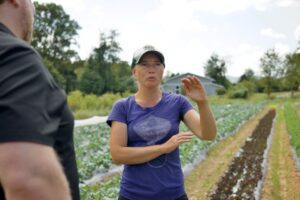
I’ve been farming this land for twenty years. Ivy Creek Family Farm is a diversified vegetable farm — we grow eleven months out of the year, in hoop houses and open fields. My home is just up the hill. My kids play in these fields. And every season, I feed my neighbors. There’s something wonderful and something hard about that kind of closeness. Farming never stops. You have baby plants to keep alive twenty-four hours a day, seven days a week, and when it doesn’t rain for three weeks, you’re irrigating every other day. But being this close means I know my community, and my community knows me.
Most small-scale farmers are good stewards of the land, because we have to be. We’re building soil as much as we’re growing vegetables. We’re thinking about the next generation as much as we’re thinking about tomorrow. Farming is unpredictable in a way that’s hard to explain unless you’ve lived it. You can put six months of work into a crop, do everything right, choose the right variety, tend it carefully — and lose all of it to one unexpected frost, one wrong forecast, one hailstorm, one deer. In 2026, weather and disease pressure are only adding to that. Every career right now requires adaptability. Farming asks for it minute to minute.
That’s part of why diversification matters so much for community resilience. A diversified vegetable farm is like a good financial portfolio — in a hard year for peppers, it might be a great year for brassicas. If I have a bad season for tomatoes, I likely have a strong one for something else, and that means I can still show up for my community with great food, because of the skill set and the range I’ve built over twenty years.
Nothing tested that resilience like Hurricane Helene. During the storm, there was water above my head where we’re standing right now. The small creek — North Fork of the Ivy — became a raging river in about forty-five minutes. I was on one side of it at seven o’clock, and by nine, that whole area was underwater. First came the immediate emergency: trying to save what structures we could. Then, once the water dropped, came the new reality — roads gone in six-foot craters, our bridge broken, trees piled everywhere. We had to figure out how to even reach the farm before we could assess what was left.
We lost most of our crops. It happened on a Friday — we had about eight thousand dollars of produce ready for market the next day, and our walk-in coolers flooded. Our storage crops, the potatoes, winter squash, onions, all gone. Our barn filled up like a bathtub; every tool I’d custom-built over eighteen years disappeared under the water, and in its place were three pallets of soaked boxes. The foundation of the barn was gone. A whole building was simply gone. And our neighbors were in exactly the same shock we were.
You can do all the right things, be incredibly skilled, do the research, treat your crops well for months and months — and then something can go wrong, and you can lose all of it.
- • •
My relationship with MANNA FoodBank started in May of 2026 — nearly two years after the storm. That was the first year I’d brought topsoil back in, planted cover crops, and restored my fields. It was a slow process of rebuilding the resources just to get back to planting.
When it came time to decide what to plant and how much to reinvest, I heard about MANNA’s Essential Foods program. It was meant to replace a program we’d lost, and the goal was simple: get great local food into food pantries. When MANNA came through, it gave me the confidence to make a hard decision — whether to put my life savings back into this farm. Knowing that MANNA FoodBank and other organizations were there, saying, “if you grow it, we’ll buy it, and we’ll get it to your community” — that mattered enormously when I was deciding whether to rebuild after a crisis.
What strikes me most about MANNA FoodBank is that they’ve been part of this community for decades. They experienced their own losses during Helene, and I remember reaching out to them, wanting to help, knowing this foundational organization in our community was suffering too. And then they rebuilt, looked outward, and recognized that farmers were part of the need. So many disaster-relief organizations show up for a moment and then leave. MANNA was here before the hurricane, went through it with us, and has stayed — not just one year later, but two, three years later — because that’s genuinely what it takes to rebuild a community.
Even without Helene, MANNA FoodBank plays an essential role in building food resilience across our whole system. What I love most about the Essential Foods program I’m part of is that it addresses an acute problem with a systemic solution. It doesn’t start with the empty plate — it starts with the seed that gets planted. That’s when real change happens, and it’s happening on my farm because of MANNA. It lets me show up for my community in a long-term, sustainable way, with ripple effects that go well beyond any single harvest.
- • •
The food pantry I deliver to is about two miles from here. On the drive, I pass homes that still haven’t been rebuilt since the hurricane, and bridges still under repair. When I arrive, I see the pantry itself — flooded during the storm, rebuilt mostly by the county — now fitted with beautiful new refrigerators MANNA donated, with glass fronts so clients can see what’s available and choose what they actually want, instead of just receiving whatever’s handed to them.
Lately I’ve been arriving with a van load of yellow, red, and purple tomatoes, crisp radishes, kale — harvested that day or the day before. I get there about an hour before the pantry opens, which means there’s no lengthy storage or transport chain. My food doesn’t go to a warehouse first; it goes straight to the pantry. That cuts out transportation costs and the volunteer hours it used to take to move it. Outside, before the doors even open, there are bags lined up holding people’s places in line, and people sitting in the shade, waiting — sometimes for hours — because they need this food that badly.
They watch me pull in and light up. “Tell me about these tomatoes.” “That was the best tomato I’ve ever had.” That direct connection means everything to me — I get to hear what they love, take that home, and let it shape what I plant next season, so the food I bring keeps getting better for the people eating it. There’s a woman who comes in who just turned ninety; the pantry helped her celebrate that birthday. I watched her walk up to the tomatoes, look them over, and start filling her bag. There is nothing better than watching an elder neighbor receive something that’s truly a gift — not blemished, not a last resort, but something nourishing that will carry her through the whole week until the next pantry day.
I hurry in, because I’m a farmer and there’s always a fire to put out somewhere. But when I get there, I have a whole crew waiting — Spanish-speaking volunteers, elders, teenagers — everyone grabbing a crate off the van. It’s like a parade of fresh vegetables moving into the pantry, and then out into the community.
When I think about food insecurity and resilience across Western North Carolina, I believe MANNA FoodBank is the leader in this work. There are dozens of organizations supporting farms or getting food to people in need, but MANNA is the one truly setting the tone for this community’s conversation. A good leader leads by example, and that’s what this program does — it tells our neighbors, our community members, and every other organization working in this space that systemic change is worth prioritizing for the long term. Because of MANNA’s history here, they know this community deeply, and knowing this community means knowing its farmers, too. Western North Carolina has always been a community of farmers. We’re a rural place, and farms are a vital part of what holds our food systems together. And I think that’s the real gift MANNA has given me — turning a disaster into a turning point, not just for my farm, but for our food system, our food pantries, and our farmers.
Ivy Creek Family Farm is a diversified vegetable farm in Western North Carolina and a local produce partner of MANNA FoodBank.